Looking for a high profit business low investment opportunity? One of the best business models you can use is the affiliate marketing business model. Affiliates join programs and promote other people’s products online. Anyone can use the model to earn money from the sale of other people’s products and services world-wide. Due to the automation and scale you can use with affiliate marketing it offers potentially unlimited profit while at the same time it’s also a very low investment opportunity.
Amazon, for instance is one of the most popular affiliate platforms. Anyone can join Amazon’s partner program, get an affiliate link and promote it to earn money. They can even do this absolutely free. The most important tools for affiliate marketing is a laptop and internet connection, which many people already have. Besides that investment the best investment you can make with affiliate marketing is in your training. It’s definitely worth paying for some training with affiliate marketing and properly educating yourself because around 95% of affiliates don’t succeed! This, in part, is due to the low barriers to entry and the fact that pretty much anyone can “give it a go”!
High Profit Business Low Investment: What Do Affiliates Do?
There’s many ways to promote affiliate products online and many different products you can choose from. Your choice of promotion method and products (more on this later) plays an important part in whether you’re successful or not! The main promotion methods which affiliates use to promote products online are:
Content creation: blogging, video blogging, etc.
PPC – pay per click direct marketing, using ad platforms such as Google Adwords
To grow and scale an affiliate business quickly, you should focus your attention on the most scalable marketing strategy: paid marketing. With paid marketing, once you’re in profit, you can simply turn up the marketing budget to sell more products. The skill therefore is testing and measuring ads to find a profitable one. This can take some time. A slower less scaleable marketing strategy (but cheaper) is to create content through blogging or creating videos, for example.
High Profit Business Low Investment: Products
There’s many different types of products you can promote as an affiliate too! Some products pay much more than others and some even pay recurring income. The highest paying products (high ticket products) are well worth focusing your time on because one sale can pay as much as selling hundreds (or even thousands) of lower valued products. This means you can profit from fewer sales, if you choose the right products.
Subscription affiliate products carry ongoing membership fees and many of these offer ongoing recurring commissions for affiliates. These are obviously a good idea too, because they help affiliates build a consistent income from sales much more quickly.
Top affiliates think big and focus on finding products which are super valuable and offer both high ticket commissions and recurring commissions. A valuable product will be potentially used for the lifetime of the customer, so if they carry a recurring commission, this is obviously very good for the referrers of these products. Products such as business tools and software for online businesses are incredibly valuable because they help people to earn a living. Once someone is profitable using these tools, they are more likely to maintain their memberships.
A good example of such a tool is Aweber, which is an email autoresponder used by affiliate marketers and many other businesses. It lets affiliates build a huge list of subscribers and promote their affiliate products simultaneously to thousands of people at once. Using paid marketing and an email autoresponder in conjunction with each other is one of the best ways to build a lucrative online business. If you also choose high ticket product range, which includes the use of subscription products, you’re giving yourself the best change for success! See best products to sell as an affiliate.
Summary
A high profit business low investment opportunity might be any kind of e-commerce business. However, affiliate marketing is one of the most potentially profitable and easiest business models to use for anyone entering the space with no previous experience. That’s not to say affiliate marketing is easy, but the barrier to entry makes it affordable for most people. If you treat it seriously, as a serious business, affiliate marketing can be very lucrative, even for little investment and training.
Still, you should expect to work for several months building your business before you can expect a return, according to your products, marketing budget and time invested. For more information, checkout this free video series.
Can you really get free leads for affiliate marketing? There’s two main ways to get leads as an affiliate. You can either pay for leads or earn them! To get a lead you need an email autoresponder which allows you to collect email subscribers from a website or web page. You can get one for free here.
If you don’t have a website, it’s well worth building a website which you own. If you want free leads, it’s worth looking at my article on how to build a niche website. A niche website can help you attract traffic for free. Traffic is the most important element of attracting free leads. Without traffic you won’t attract any leads.
Free Website/Landing Page
If you want a free website to use for leads, you can use Weebly.com. Weebly lets you build a simple website for free and place a lead capture form on it. However, a Weebly website address looks less professional than your own domain name, so it’s worth getting your own domain and hosting if you’re serious about free leads.
Inside Weebly.com, grab your form code from Aweber and use the Embed Code module to place on your new website. Publish, and hey presto you have a landing page!
If you’re using Weebly, for a free site, I would suggest to at least buy a domain name which you can point to your Weebly website. That way, as you use the methods described in this article, you’ll look more attractive to your prospective visitors. Still, many people use Weebly to great effect and you don’t have to spend anything!
You can also use Aweber to create a landing page too, although your link will often look long and messy so it’s worth purchasing a domain name to forward to it to make it look more professional.
Free Leads For Affiliate Marketing: Capture Form
Your lead capture form is an important part of this process and that’s the page visitors will see when they come to your page to enter their details. Your page should communicate your most important message in simple terms and focus on the benefits rather than the features of whatever you’re offering. Here’s a lead capture form I have used to collect emails:
The features of your offering might be interesting for you (the affiliate) but mostly won’t be of interest to your would-be subscribers! If they are going to hand over their email address and give you their trust, you need to focus on WIIFM: What’s In It For Me – or for them, (your visitors)! Therefore your landing page should have a clear benefit driven call to action. It’s worth doing some research on this topic because a good landing page will convert many more visitors into subscribers than a bad one! See also why use landing pages.
The best way to find your best performing landing page is to run paid marketing to one and test it for yourself. Cross test different landing pages using differing images, titles, colours and forms etc. But of course this involves spending money and this article is about free leads for affiliate marketing. There’s also software you can purchase which will help you determine the best performing landing page for your target audience.
Free Leads For Affiliate Marketing: Blogging
You can get free leads for affiliate marketing through blogging. However, don’t expect much too quickly. It can take months of blogging before you “break through” and start seeing organic traffic coming to your blog. Even then, much of your traffic won’t convert into subscribers. A very small percentage of your traffic will likely convert into leads. For more about blogging checkout my article niche blogging for profit.
To convert traffic from a blog into leads you can use lead capture forms and pop ups, which you can find on Aweber. Pop ups are good for collecting leads because they ensure everyone who lands on your website sees your offer. You have probably been annoyed by the popup on this website already!? Even though I hate popups too, they are a great way to collect leads for free from a website.
Pop Ups, drop downs and standard opt in forms are all useful to collect leads and the more options you have on your site, the more chances a visitor will opt in. Another good plugin I use for opt ins is called Icegram (By Icegram). It’s a free plugin for WordPress and offers multiple op in offers for websites. I use Icegram opt ins on this website and you’ve probably seen the drop down webinar offer I use for free opt ins?
Free Leads For Affiliate Marketing: Ebooks & Pdf’s
Ebooks are a great lead magnet for affiliates. Your ebook should lead the right kind of people into your email list. Ideally create an ebook which matches your affiliate products in some way. Once you have created your ebook, set up your landing page or website to showcase it to all visitors. I have used multiple ebooks to get many leads. Once you have created an ebook, you can also build content around your landing page to attract traffic organically. Pdf’s are also a great thing to offer on your website because they typically have much lower competition on the search engines.
Here’s an ebook I offer which has helped me get thousands of leads for free just by putting it on my blog:
Free Leads For Affiliate Marketing: Traffic
So we have so far mentioned landing pages, popups and just touched on blogging. The key ingredient in getting free leads for affiliate marketing is getting your offer in front of people who are interested in it! Firstly you should get to know your customer avatar. This is an important step and can save you heaps of time and frustration if you do this. Do yourself a favour and checkout the article on target audience for affiliate marketing and the customer avatar worksheet pdf. Understanding who it is who will want what you have got will save you a lot of time and wasted effort.
There’s a few ways to generate traffic to your website or landing page for free. Blogging, YouTube videos, social media websites etc are all platforms where you can find your target audience from. To get free leads you need to trade time focusing on activities which bring people to your landing page/website. Unfortunately this takes time and effort, but your efforts will compound if you stick with it for long enough! Here’s a few basic free strategies you can use to drive traffic to your website or landing page:
Blogging
Quora.com
Facebook
YouTube
SEO – Search engine optimisation
Blogging
Blogging, as mentioned is a long term and slow strategy. But you can get some great results with it if you get clear on who you’re targeting with your posts. I love blogging and have made it a focus on my free lead generation strategy. But it did take some time before results started to come in regularly, so you need a long term approach. the best way to stick at it for long enough to matter is to choose a topic you’re interested in, or passionate about. Ideally both! If you can’t imagine writing blog posts about your topic for at least a few months, it’s probably not the topic for you!
To find suitable blog posts for my potential leads I use Google’s keyword planner to find long tail keywords with low SEO difficulty. By typing in your main keywords you can find the “low hanging fruit” of keywords which offer much less competition on the search engines. If you do your homework, these little “gems’ can give you free rankings on Google, Bing, Yahoo and other search engines. When you get free listings you get free traffic. Checkout my article on this strategy here. Blogging is a huge topic and you can do a lot with the content you have created too:
Link building
Sharing on social media sites
SEO – search engine optimisation
Posting on question and answer websites
Quora.com
Quora.com is a question and answer website that allows anyone to answer questions in their field of expertise. For affiliates this means you can attract free traffic and send that traffic to your landing page or website. You can set up you bio on Quora in such a way as to draw people to your landing page, where you can collect their email address. Here’s what my bio looks like on Quora.com:
Again, as previously mentioned, your CTA (call to action) needs to be focused on the benefits of your offer.
Once you have set up your bio, you need to attract traffic to it! You can do this by getting active on the platform and answering questions which are associated with problems your customer avatar might be having.
As you answer questions, you can also link your answers to relevant content you have created on a website. This gives you two possible opportunities of attracting leads: from your website and from your bio. The more questions you answer in your niche, the more people will see your bio and links. You can’t however directly link to affiliate products in your answers. If you do, you’ll likely have your answers deleted. See also affiliate marketing on Quora for more on this strategy.
Facebook
Facebook is another platform which can be used to attract traffic to your landing page/website. You can set up your Facebook profile to showcase your offer. Here’s what mine looks like:
Once you have set up your bio, you need to attract the kind of people who will be likely to have an interest in your offer. Again, check back to your customer avatar worksheet pdf to learn about who your “perfect customers” are! Where do they hang out on Facebook? Facebook has a number of groups you can join where you can find new people and interact with them around specific topics. So for example if you’re promoting some kind of fitness product, you might start looking for weight loss groups, or fitness groups of some kind.
Ask to join the groups by filling out any questions and agreeing to the spam terms etc. Once you join a group you can interact with other group members around certain topics of interest. Don’t spam groups with your affiliate links or websites! This will likely get you banned! Instead, interact with people naturally and get involved in the conversation. Make a habit of this and spend some time every day in the groups. Over time, people will naturally look at your profile and see your offer. See also unpaid social media marketing.
YouTube: Organic Marketing
You can also use YouTube for marketing your content organically. This is done in much the same way as blogging, only with video. research your keywords first and find longer tail keywords for your video titles which have less competition. YouTube is pretty competitive too and you’ll need to upload videos regularly for some considerable time to generate free traffic from the platform. But once you do you can send traffic to your landing page or website by linking to it on each of your videos.
Again the best topic to choose is one in which you have an interest or passion and one which you can maintain your enthusiasm in over the longer term.
Summary
Obviously there’s a few strategies you can use here and you can’t do them all at once in any great depth. You will probably gravitate towards a particular strategy and if so that’s where you should aim to focus your time. These strategies won’t give you tonnes of leads overnight.
They only work over time and you’ll likely see sporadic results at first, which should compound over time. Pick a strategy you like and stick to it for several weeks, working on it every day. Depending on your affiliate niche, the time it takes will vary. Make sure you do the work on your landing page and make your offer desirable, otherwise you’ll find it more difficult getting leads.
Spend some time learning about your customer avatar and the type of person you want to attract. I’ve had some great results using these techniques but if you don’t put in the work you can’t expect to get the results! Paid marketing is of course much faster and more scaleable. So if you don’t have the patience for these kinds of strategies you should look at some cheap methods using paid marketing. Retargeting organic traffic is quite cheap and you can also use Google’s dynamic ads which works well in combination with blogging and organic marketing.
Welcome to the 15 day challenge affiliate marketing step by step foundation process. In this challenge you will be working through a free video series and then accessing an affiliate platform where you’ll complete a number of training videos. Let’s have a look at the first step of the challenge!
15 Day Challenge Affiliate Marketing: Step 1
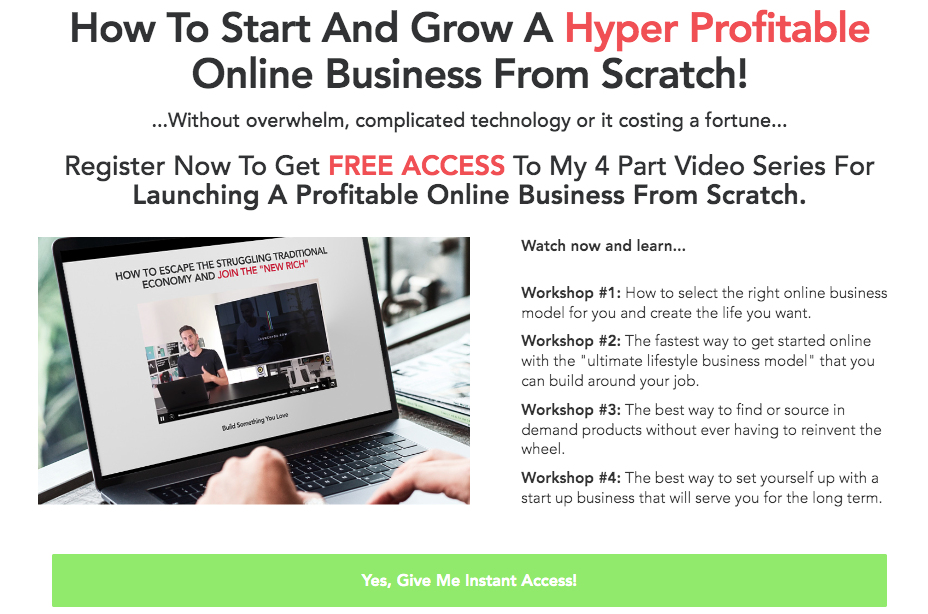
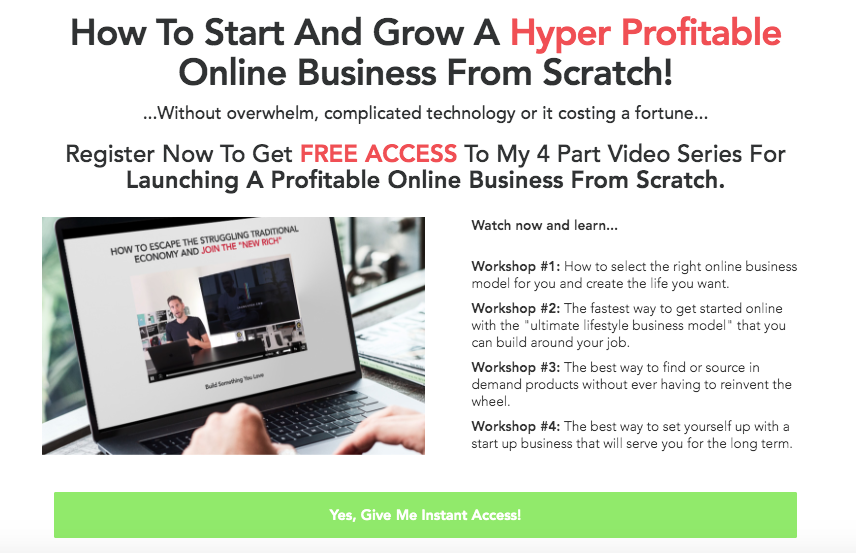
To get started on this affiliate marketing challenge, you first need to sign up to the free video series. This is so you can start working through the videos. Click on the image below to do this and complete step 1:
Once you’ve filled out the form and entered your name an email address, head over to your inbox and check for the message you’ve been sent. You may need to look in your promotions tab and/or spam filters to find the message.
15 Day Affiliate Marketing Challenge: Step 2
Once you find the email in your inbox, have a read through and click on the link in it. This will take you through to your first training video:
This first video is 30 minutes long and completes day 1 of the 15 day affiliate marketing challenge! If you’ve not done this yet, click here to access the course.
15 Day Affiliate Marketing Challenge: Day 2
On day 2 you should find another email in your inbox which will arrive at around the same time as you signed up for the first video. Check your inbox and spam filters if you can’t find the email. Once you’ve found it, click on the link in the email and play the video:
This video is 43 minutes long and will give you an overview of the different affiliate business models you can use. For example, by choosing to sell subscription affiliate products and high ticket affiliate products you can considerably improve your results as an affiliate, even with the same amount of effort as you would need selling low value products.
15 Day Affiliate Marketing Challenge: Day 3
On day 3 check your inbox again and you should find the third video in the series. Workshop 3 covers sourcing and selling physical products online.
This video is 36 minutes and will explain some of the ways you can earn from the internet without investment using existing products. By choosing products and services around an interest or hobby you might have, you can even earn doing something you’re passionate about.
15 Day Affiliate Marketing Challenge: Day 4
Day 4 : guess what!? Check your inbox for the next email in the series which will lead you to video 4:
This video is 30 minutes long. Here you will learn more about Stuart’s online community The Modern Wealthy. Once you have completed the video click on the button underneath it and start your journey! If you haven’t started yet, you can sign up for the videos here.
15 Day Affiliate Marketing Challenge: Day 5
It’s day 5 of the 15 day affiliate marketing challenge! Today is the day to sign up to The Modern Wealthy affiliate portal and work through the training videos and action steps. You can do that by clicking here or on the image below:
This will take you to a sign up page (See below) where you can access a free account and start learning about how you can grow a profitable online business from scratch.
Day 6
Once inside the platform you will find a number of action steps to work through. Here’s some of what’s included:
The step for day 6 is to make a start on the steps which you’ll see in your dashboard once you’re inside. Step 1 is to download and read the ebook.
Day 7-15: Join The Modern Wealthy Facebook Group & Work Through Remaining Steps
Click on the link in your platform for step 2 and this will take you to The Modern Wealthy Facebook group. Inside the group you’ll be able to interact with other members and introduce yourself.
Follow the steps until you have completed all the modules. In step 4 you can schedule a free call with a consultant. They will help you decide on a further route if appropriate to help you get started with your online business needs.
Complete the bonuses and begin the best live blueprint to complete the challenge! Finished? Congratulations, give yourself a pat on the back for following through and staying the course! Not started yet? Shame on you, go back to step 1 and join the free video series here or access the portal here !
The affiliate marketing customer journey is the journey for a customer from their first “touch point” of marketing to the end product; from an affiliate’s perspective. Before making a purchase, a customer will often look for a particular piece of information. A review, for example, is something someone might look for if they intend to make a purchase. The “customer journey” leads the prospective buyer from the review directly to the sales page of the product they want. This, as an example would be a pretty short customer journey: A Google search (for a product review), they find the review article, this leads them to the product, they make the purchase.
However, it often will take multiple points of interaction before someone actually buys something (from an affiliate). See also how many touch points before a sale. Research shows that it will often take between 6 and 8 touch points before a purchase is made. These points of interaction are what affiliate marketers use to help customers make a buying decision. If a customer journey isn’t smooth and congruent, there’s much more chance of a potential customer going elsewhere. But if your marketing structure leads customers on a congruent path, they are more likely to remain on that path. This is particularly true if your marketing messages are aligned with the customer’s needs, and leads them to a product/service which is useful to them.
Affiliate Marketing Customer Journey: The Customer’s Needs
To help affiliates align their marketing messages with the needs of their potential customers, they need to understand their customers! In particular, they need to understand that sub-section of the online marketplace who will value and invest in their products. The “perfect customer” is one who will buy from you again and again and become a life-long supporter of your products. Getting clear on who your products serve is a good way to define your perfect customer avatar, and ultimately define your target audience for affiliate marketing.
These are just a few things you should get to know about your customer avatar:
How old they are
Where they live
Where they hand out online
What kind of information they look for
The more you know about your customer avatar, the better you can find them online and communicate your message to them in a language they can relate to and understand. See customer avatar worksheet pdf for more on learning about your perfect customer. Once you have carefully defined your customer avatar, you can create content or run ads which will speak directly to them, based on their needs, pains and/or desires. This will ultimately be the first contact point where your marketing efforts find prospective customers.
Affiliate Marketing Customer Journey: Flow
The “flow” from one piece of marketing to another is pretty important on the customer journey. For example, if you saw a YouTube advert and decided to click through to learn more about the offer, you would expect similar messaging on the landing page you were sent to. Even a small deviation from the theme of the original advert might put a customer off taking further action. Here’s an example on one of my YouTube videos which leads visitors to a similar looking landing page.
The landing page below confirms the message of the video the visitor has just been watching. If the landing page wasn’t congruent with the earlier video/marketing message there’s a large chance that someone might think there was an error and click away. Or they might click away because the next step involves them handing over some information – their email and name!
To create flow in your marketing messages from one platform to another, it’s important to understand the needs of the customer and the most important details in the previous message. If the next webpage, or landing page, or video doesn’t connect the customer with the previous message, they are likely to click away, and be gone forever! A good customer journey is congruent all the way through.
Keeping in mind that many customers will require between 6 and 8 touch points before they make a purchase, each interaction in your marketing strategy should carry on the theme from the last, to keep engaging with your audience and meet their needs. Many affiliates will use email marketing and retargeting to maintain this connection through their marketing strategies.
An email marketing follow up series is particularly useful to build trust and deliver value to your potential customers. It gives the affiliate the potential of connecting with their audience multiple times over a longer period of time. You simply could not you could achieve this just from a website.
Likewise with retargeting. With retargeting you are putting advertising messages in front of people who have already interacted with your marketing somewhere before. You can also choose to show advertising according to the actions they have taken previously on a website, for example. So for example, if someone nearly bought something from your website, and left the cart before paying, you can choose a congruent advert to relay that message to them and remind them of their purchase!
Retargeting is very effective for affiliates because you are placing advertising messages in front of people who are warm or hot buyers. They have already taken some action on your website or your marketing materials. So they are more likely than most general website traffic to want your products/service.
Summary
The affiliate marketing customer journey is an important thing for affiliates to understand. If you attract the wrong audience, you will struggle to sell anything as an affiliate. You can also break rapport with potential customers by sending out disconnected messages, which disrupts the smooth journey you ideally want to create for them.
Ultimately the affiliate marketing customer journey should be one which leads people to products they actually want and value, and that you actually want and value too! So if you don’t believe in the products yourself, there’s already a disconnect in your authenticity. This will likely show up in your marketing messages too!
With the right products and once you have learned about your perfect customer avatar, you are definitely a lot further along than many other affiliates. To access a free video series and learn more about affiliate marketing click here.
What are the components of affiliate marketing? Affiliate marketing is a performance based business model in which affiliates refer people to products/services online.
The affiliate doesn’t need to personally own these products and product owners are known as “vendors” or “merchants“. The “network” is the company or body providing the connection between the vendor and the affiliate. It provides a platform in which affiliates can connect to products.
When they refer a product through their affiliate link, the network credits them with the sale so they can be paid. The “publisher” is another term used for the affiliate who is the referrer of the products. Finally we have the customer. So the basic components of affiliate marketing consist of:
The “vendor” or product owner or “merchant”
The “network” connecting the vendor to the affiliate
The “publisher” or “affiliate” who refers the products online via marketing strategies
The customer who purchases the product.
Components Of Affiliate Marketing
So, the vendor, the network, the affiliate and the customer make up the main components of affiliate marketing. But there are many other components which the affiliate must understand in order to promote the products themselves. Affiliates only get paid if they successfully refer a product to a customer online. This takes some time and effort to learn and around 95% of affiliate quit. There’s several components within affiliate marketing which an affiliate needs to understand in order to give themselves the best chance of success:
The target audience – the sub-section of the online community who are the most interested (and most likely to buy) their particular products or services.
Marketing strategy – not all affiliates use the same methods of selling online. To be successful as an affiliate you need to learn at least one marketing strategy well enough to make consistent sales.
The customer avatar – is also part of the target audience. The “customer avatar” is the type of person who is likely to be your “perfect customer”.
Data and analytics – affiliates collect data when they run advertisements or create content so they know which content performs the best.
Email marketing – is a large component of affiliate marketing strategy for many affiliates. By collecting email subscribers they can build an ever growing list of people who fit the description of their customer avatar.
Components Of Affiliate Marketing: Marketing/Advertising Methods
The marketing side of affiliate marketing is a huge topic and can be broken down into further components for simplification. Some affiliates will use paid marketing methods such as Google Adwords. Others might build content (such as this article), using SEO (search engine optimisation) to drive their traffic source. SEO can also be broken down into many components too such as link building, content creation, social media sharing etc. Here’s a few of the main marketing methods used by affiliates:
Blogging – writing content on a website to attract the customer avatar/target audience
Video blogging – uploading videos to YouTube or TikTok and attracting an audience (with the purpose of selling affiliate products through the affiliate link)
PPC – pay per click (direct response) advertising allows affiliates to test adverts and collect data to improve performance.
Social media advertising – both paid and unpaid social media marketing can be used by affiliates to attract an audience for their products.
SEO – search engine optimisation is used to optimise content created on a blog or with video and may involve link building, content sharing and other methods to increase domain authority or reach.
Components Of Affiliate Marketing: Blogging
Blogging is a popular way to promote affiliate products and involves building content on a website like this one. Again, blogging can be broken down into many components to achieve the best results for an affiliate:
Creating content – writing specific content which will attract the right target audience
Content promotion – sharing that content: posting to social media, linking from other websites (guest posting), blog commenting, etc.
Blogging automation tools – bloggers will often use automated tools which help them syndicate their content more easily. See auto post to social media from WordPress.
SEO – search engine optimisation can be done both on-site and off site; using link building strategies and SEO plugins. See best free blog plugins for WordPress. Content creation is also a major factor for SEO.
Summary
As you can see there are many components to affiliate marketing.
The “vendor” or product owner or “merchant” The “network” connecting the vendor to the affiliate The “publisher” or “affiliate” who refers the products online via marketing strategies The customer who purchases the product.
Components For Affiliates
For affiliates there are other components which they must understand to successfully sell their products:
Targeted audience – who is your “perfect” customer
Marketing Strategy – How will you attract them?
Customer Avatar – Specifics of your perfect customer
Data & Analytics – help with your optimisation
Email marketing – collecting subscribers
Marketing Strategies
Marketing strategies can be broken down into different methods:
Blogging
Video blogging
PPC – pay per click
Social media
SEO – search engine optimisation
Blogging Components
And even each marketing strategy can be further broken down into smaller components. For example with blogging:
Content creation – Creating content on a website whether written on video
Content promotion – promoting the content in whatever way appropriate
Tools – plugins and data collection tools to help optimise your efforts
SEO – search engine optimisation to help gain organic traffic
Link building – to increase domain authority and Google rankings etc.
What is the work of affiliate marketing? Many people are hearing about affiliate marketing but don’t know what’s involved. What do affiliate marketers do exactly?
Affiliate marketing is an online business model in which third parties promote and sell other people’s products online. There’s thousands of affiliate products which you can sell, and many ways to sell them. Different affiliates have different approaches to selling too. Some of the most common ways to sell affiliate products online are:
Content marketing and SEO – search engine optimisation. This might be strategies such as blogging or video blogging also know as “v’logging”
PPC – pay per click advertising. There’s a variety of advertising platforms which affiliates use such as YouTube, Adwords, Bing etc. They run ads and send traffic to affiliate products
Email marketing – most top affiliates will have an email list of subscribers. They send regular messages to their subscribers helping them with a specific problem and selling their products to their list at the same time.
Social media – many affiliates use their social media accounts in one way or another, either with paid marketing or organic methods of finding customers for their products.
What Is The Work Of Affiliate Marketing? Join A Program
The first step for affiliates is to join an affiliate program. One of the most popular affiliate programs is Amazon’s and anyone can join providing they meet Amazon’s partner program criteria.
Joining a program is usually just a matter to filling out a form. Although some programs will require you to already have a website and a number of email subscribers. Once you have joined a program you can choose a product to promote and get your unique affiliate link. An affiliate link is a unique identifying code which allows programs to credit referrers when they make a sale.
To make sales, affiliates need to learn some kind of marketing strategy where they can attract paying customers through their links. This is the most difficult part of affiliate marketing and as such the part which requires the most amount of focus in order for an affiliate to become successful. To summarise the work of affiliate marketing, it is the “marketing” part of the business. Most affiliates will need to learn some kind of digital marketing strategy, in order to make sales.
What Is The Work Of Affiliate Marketing? Running Ads/Creating Content
How you sell your affiliate products will determine a number of things for affiliates:
How successful they are
The time period it takes
The amount of work they need to do
The scalability in their business and the ability to automate it
Many affiliates, for example will start by blogging and although blogging is a method of affiliate marketing which can work well, it’s a long term strategy. A faster strategy to use is paid marketing. With paid marketing platforms, you can experience almost instant traffic, for example. But with blogging and SEO (search engine optimisation), results can be much, much slower.
Bloggers create content on their website and optimise it for the search engines. If successful, their content will get traction and they will make sales organically. Over time, if they stick with it for long enough, they can generate passive income from blogging. Depending on the topic of their blog and the relative competitiveness, this can take weeks, months or even years!
With paid marketing, affiliates use targeted advertising to place their marketing message in front of prospective customers. For example, Google Adwords lets marketers target adverts based on Google search traffic. By finding specific keywords which relate to their affiliate products, affiliates place ads in front of people who are likely to buy. The target audience for affiliate marketing is the specific section of online visitors who would be most likely to buy your particular product/service.
Data Analysis
Whatever method of marketing an affiliate uses, some of their work will involve analysing their data. With paid advertising, over time affiliates will gather data on their ads and their sales. By compiling data over various different ads, targeting and sales pages, they can determine very accurately which ads are performing the best. Once they know this they can cut off ads which aren’t performing and scale up ads which do!
Ultimately the aim is to be running advertising/marketing which is generating sales and profit for the affiliate. In the first instance this can be a tough journey, especially if ads aren’t performing. A lot of affiliates will quit during this time and assume that their business just doesn’t work! But this is a mistake, and although learning advertising techniques can be tough, in the long run, affiliates who stick the course can earn an automated income through running ads and selling affiliate products.
Email Marketing
Most long term affiliate marketers have an email marketing list. They build a large list of subscribers who opt in to receiving messages about a particular topic or interest. The affiliate then automates a number of email messages which are sent on a regular basis to follow up with each subscriber. Over time, as your email list grows you should find more and more of your subscribers are buying affiliate products from you.
Anyone can build an email list in a number of ways and first you should get access to an email autoresponder. Get one free here.
Once they have an autoresponder, affiliates build their lists in a few main ways:
They create an opt in offer on a website, and build traffic through blogging
They create specific landing pages and send traffic there with paid or organic marketing methods.
They offer a free giveaway such as an ebook, pdf download or some information giveaway
Keyword Research
Bloggers and video content creators often use keyword research in order to find the keywords which are likely to perform the best. With blogging, many keywords are too competitive to rank on the search results pages in Google, for example. So many bloggers will look for the long tail keywords with low SEO difficulty. These are the keywords which are much more likely to show up in the search results if they create content for them.
Keyword research can be done with many free and paid for tools one of which is Google’s keyword planner. By using the planner to find keywords which relate to your particular topic, you can be much more targeted when it comes to creating content.
If you target content specifically, you can make your work as an affiliate go further than by simply writing/creating content about random topics in your niche.
Training & Education
The most important step to consider if you’re thinking of becoming an affiliate marketing is training and education. It’s pretty easy to join an affiliate program but much more difficult to effectively sell affiliate products. Around 95% of affiliates will quit and most assume it’s far easier than it really is to become successful as an affiliate.
If you get the proper training and stick with it over the longer term, your chances of success are far higher than most.
How does high ticket affiliate marketing work? High ticket affiliate marketing is the same as any affiliate product, only with more expensive products. Typically a high ticket product will pay much more than a standard affiliate product will. Most affiliate products and programs have items costing less than $100, for example.
Amazon, one of the most popular affiliate programs, has thousands of products you can promote on their site. But most of these products are valued at $100 or less. Amazon pays affiliates between 1% and 20% commission on its products with most of its commissions falling into the 3-10% range.
If you decide to promote products valued at $50 and which pay only 10% commission, you’re going to need to sell a lot of products to become profitable as an affiliate; at only $5 commission per sale! But with high ticket affiliate programs, you can make fewer sales and make more money. This is because the products are valued higher or because the commission is a larger percentage of the sale value (or both).
How Does High Ticket Affiliate Marketing Work?
With high ticket products, you will typically make over $500 per sale, due to the higher sale value of the product. Here’s an example of a high ticket product. This submarine costs $300,000! By joining the affiliate program at Hammacher Schlemmer, the website which sells this item, anyone can then promote their unique affiliate link to the item. If you make a sale through your link, you earn 8% of the sale value. This would give you an affiliate commission of $24,000!
There are of course far fewer people looking to spend £300,000 on an Amphibious vehicle than there are looking to spend $100 or less on Amazon! However, as an affiliate it’s worth far more to sell one such item than the many items you would need to sell with a low value product. For example, let’s compare this to selling a $100 item from Amazon, with a 10% commission. To make the same as this one sale of the watercraft, you would need to sell 2400 items from Amazon!
Despite the fact that a high ticket item like this is more difficult to sell, it’s never 2400 times as difficult! In fact, often is the case that the work will be very similar in attracting customers for either item. Once you have learned how to attract the right audience for your products and services as an affiliate, you can promote anything you like. So it can be much more lucrative to go after customers for larger valued items, once you understand how to sell online.
How Does High Ticket Affiliate Marketing Work?
Of course the Submarine/watercraft is an extreme example, and there’s many other affiliate products you can promote which have a smaller price tag than $300,000! Here’s another example of a high ticket product you can sell as an affiliate:
The “Aquatic Gymnasium” is priced at $10,000 and would give an affiliate an $800 commission if they made a sale. Here’s another item. The Climbing Wall Treadmill is valued at $9950 and pays out $800 commissions to affiliates.
High ticket affiliate marketing is the same as with all affiliate marketing products, except they carry a much larger financial reward for sales you generate. Most high ticket affiliate products will pay out at least $500. Compared to lower valued products, it’s obviously a much better way to do affiliate marketing if you’re considering becoming an affiliate.
To become an affiliate you only need to join an affiliate program. As mentioned, Amazon has one of the most popular affiliate programs online. To benefit from high ticket sales on Amazon, you just need to find their most expensive products. Here’s a few of the highest priced watches on the site.
At the time of writing Amazon pays 7% commission on it’s watches according to this chart:
A sale of one of these watches would give you an £875 commission! Once you’ve joined an affiliate program you will get access to the online dashboard where you should get your unique affiliate link. This link identifies you as the selling when you send a customer through it to the product. Once they make a purchase the sale is credited to you and you earn a commission. This is payable by the “vendor” – (product owner) or owner of the affiliate website where you have signed up.
Making Sales
To make sales as an affiliate, whether high ticket or low ticket, you need to get buying customers to click through your affiliate link and make a purchase. This can be accomplished in a number of ways but these are some of the most popular methods:
The main skill of a successful affiliate is finding a strategy they can use to sell their affiliate products. If a strategy can be automated and scaled up to a larger audience quickly, so much the better!
If you’re looking for affiliate marketing vs pyramid scheme, you’re probably wondering whether affiliate marketing is a pyramid scheme or not? Rest assured that affiliate marketing is definitely not the same as a pyramid scheme. With a pyramid scheme, you’re encouraged to involve other people with the reward of earnings for doing so. So, in some ways there are similarities. But this is where the similarity ends.
Wikipedia defines pyramid schemes as the following: “A pyramid scheme is a business model that recruits members via a promise of payments or services for enrolling others into the scheme, rather than supplying investments or sale of products. As recruiting multiplies, recruiting becomes quickly impossible, and most members are unable to profit; as such, pyramid schemes are unsustainable and often illegal.”
With affiliate marketing, you refer customers to products and services of some kind. Affiliates are third party referrers who benefit from the sale of other people’s products, mostly online.
Affiliate Marketing Vs Pyramid Scheme
A pyramid scheme is notable by lacking a trade of value of any kind. Most pyramid schemes entice people to join into a system where introducing new members results in payment. You can also earn from the recruitment of members further down the pyramid, so the more people you recruit, and the more they recruit, the more you get paid! If there’s no value other than the idea of financial reward, this is often a clue whether it is a pyramid scheme.
Pyramid schemes and multi level marketing businesses often get confused. A multi level marketing business rewards its sales people for building a team of sales people who are all selling products. If there’s no products, it’s more likely to be a pyramid scheme and less likely to be a legitimate business.
With affiliate marketing some affiliates will promote courses with a two tier commission structure. This encourages them to recruit more members because those members can add to their earnings with their sales. However, with a legitimate product, this is still legal and above board.
What Is Affiliate Marketing?
What is affiliate marketing? Affiliate marketing is a legitimate business model in which affiliates refer customers online to products and services. They don’t need to personally own those products themselves in order to benefit from their sale. Because affiliate marketing has such a low barrier to entry, there’s a lot of people who attempt it. This does make the affiliate marketing space very competitive. Many of those affiliates who attempt to make money from it fail. Around 95% of affiliates drop out which means only a small percentage actually make it work for the over the longer term.
Affiliates use all kinds of methods to get their products in front of buying customers:
PPC – pay per click advertising
Blogging
Video blogging
SEO – search engine optimisation
Email marketing
Social media
etc.
Although affiliates can use any advertising they want, most affiliates use online digital marketing strategies as apposed to traditional advertising methods.
What are some good niche ideas for affiliate marketing? Whatever your niche in affiliate marketing, your main job is to drive traffic to your offer/s. How you do this is largely going to determine whether you’re successful or not. In any niche there’s going to be competition from other affiliates and businesses. So whether you decide to focus on paid advertising or search engine optimisation (SEO)/free traffic, you’re going to need to spend time and/or money building your business.
Sadly the top paying niches are also the most competitive. So if you build a website in the hopes of attracting traffic for a top niche, your chances of getting free traffic are pretty minimal, especially without a great amount of effort. With paid marketing too, the top niches are super competitive and this drives up the price for your advertising. Top paying niches for affiliate marketing are generally thought of as:
Wealth and money making
Health and fitness
Dating and relationship
Hobbies and interests
Pets
Electronics and technology
Home & Garden
These topics are evergreen and this means they sell all year round. More “fringe” topics are generally less competitive but may also be seasonal. Christmas, Easter or seasonal products are an example of products which aren’t evergreen. They will only sell at certain times of the year.
Niche Ideas For Affiliate Marketing: Choosing Your Topic
If you’re going to build a niche website and attempt to attract free traffic from SEO, it’s a good idea to choose a topic you’re passionate about or at least interested in. Building content for SEO is a long term affair and many bloggers will quit even months into their plans when nothing happens! There’s over 600 million blogs on the internet and this means there’s a huge amount of competition, whatever your topic is. The good news is you can “niche down” into sub-topics to enable you to have an easier time of it and attract a specific audience.
So what’s a sub-niche? A sub niche is a niche within a niche. So for example, if you’re planning on building a website around the topic of Yoga, you’ll find a huge amount of competition. So you might decide to find a sub-niche within this niche such as Yoga for seniors, for example, or chair Yoga!
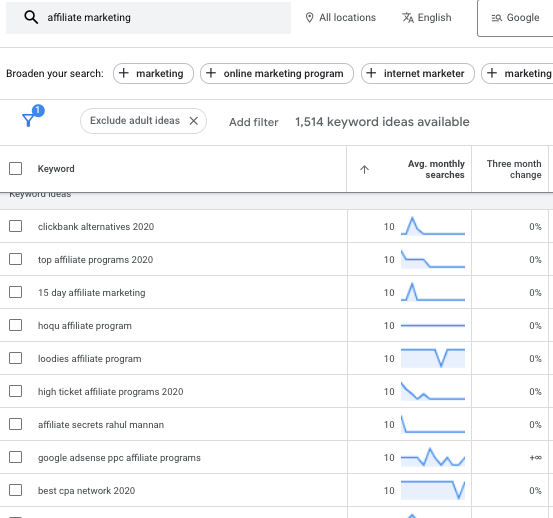
To help you find a sub niche in your chosen category, you can use Google’s free keyword planner to look for the keywords being searched for already. Here’s just a few results that come up when using the keyword planner for the term Yoga online. “Prenatal Yoga online” is one term which jumps out because it’s a potential sub niche. You could also look at “Zoom Yoga” for a website theme too if appropriate to your blog/website.
Niche Ideas For Affiliate Marketing: Ikigai
If your intention is to build a resource website, think about all the competition you’ll be facing online. In a more competitive niche, you’ll be facing much more competition. But if you use the keyword planner to niche down and find a less competitive sub-niche, as mentioned above, you’ll likely be facing less competition. Even in a less competitive niche, there will still be competition. The online world has grown rapidly and you should expect fierce competition even if you choose a lesser known topic.
To give yourself the best chance of success, it’s a good idea to focus on something you have a passion for. Ikigai is a Japanese term meaning reason for being. If you can tie in your niche with your ikigai, you will find it much easier to sustain the necessary effort over the longer term to succeed. With a topic you’re unfamiliar with, or not bothered about, it’s going to be much tougher to succeed. When you turn your passion for a subject into your vocation, you will have the edge over many other business owners who don’t care so much about their topic.
It’s therefore much better to choose a topic which you’re going to be passionate about delivering, than to aim at a topic simply because you believe it to be lucrative. Imagine yourself blogging, for example for several months and years. What topic strikes you as something you can sustain for this amount of time?
Keyword Planner
To use the keyword planner to find niche ideas for affiliate marketing start by typing a keyword or phrase into the planner. You’ll be shown many other phrases which are being searched for already. As with the example above you can find specific keywords which match your criteria and help you niche down. So for example, this website has been built on the keywords “affiliate marketing mentors”. Since “affiliate marketing” is such a competitive term, affiliate marketing mentors seemed like a good match for my site.
You can use this concept with any topic about which you have an interest. Here’s a few ideas you can use. Simply type them into Google’s keyword planner and look for longer tail keywords which would potentially make for a suitable website.
Martial arts – Tai Chi, Karate, TaeKwonDo, Kung Fu, Aikido etc.
Money saving tips – credit cards, mortgages, loans, budgeting etc.
Jewellery – home made jewellery, custom jewellery, antique jewellery
Home decor – DIY, cheap painting and decorating tips, incense and scents, furnishings
Niche Ideas For Affiliate Marketing: Products
If you’re still struggling to come up with niche ideas for affiliate marketing, there’s a few other ways you can come to decide what your niche is going to be. Some of the best paying affiliate products are those which pay high ticket affiliate commissions and recurring affiliate commissions.
By choosing a niche which attracts your target audience in the high ticket space, the same amount of sales can earn you a lot more. This is one way to get around the huge competition online. Instead of competing to get a tonne of traffic in a very busy niche, choose a topic in which you only need one or two sales in order to become profitable.
Your niche then can be chosen based on your products, rather than the other way round. To learn more about the different types of affiliate marketing products available, access this free video series.
What are your affiliate marketing objectives? Affiliate marketers are third party referral “sales” people who earn revenue from selling other people’s products online.
They are effectively self employed entrepreneurs who are mostly aiming to earn from the internet for several different reasons:
To escape having to work for an employer
For another income source
So they don’t have to commute any more and join the rush hour traffic every day
To become self employed and be their own boss.
To attain financial freedom and/or geographical freedom (work from anywhere)
In order to achieve any of these objectives, affiliates must sell affiliate products and earn enough from it to replace an existing income, or give them another source of income which can be built upon.
Affiliate Marketing Objectives: Why Affiliates Should Have Objectives & Goals
Affiliates work for themselves in an industry which is performance based. As such, unless they sell products, they don’t make any money! Since affiliate marketing is incredibly easy to get into, and not so easy to excel at, affiliates need goals and objectives to strive towards.
Without serious goals, it’s very easy to fail with affiliate marketing. Around 95% of new affiliate marketers fail and drop out. To avoid the trap of failing with affiliate marketing you need to be very serious about it and set goals. Otherwise, it’s easy to become demoralised when things don’t immediately work out!
A lot of affiliates will assume that affiliate marketing is their golden ticket to a charmed life. They set about it without really knowing what to do. When things don’t work out, instead of getting help and support, they simply quit. If you set goals and objectives for your affiliate marketing business, you are giving yourself a much better chance of success than those who simply wander into it expecting it to be easy! See also is affiliate marketing difficult?.
Affiliate Marketing Objectives: What Are They?
What are your affiliate marketing objectives? If you don’t know, it’s a good idea to get started with affiliate marketing with some training. Access a free video series to start here. Once you have begun your affiliate marketing journey, you can break down long term goals into smaller more achievable steps which you can do each day. With a large long term goal it can seem like you have a mountain to climb and this can be daunting. A good long term goal should excite you and it should also feel like a bit of a stretch.
Long Term Objectives
Long term affiliate objectives might be:
To earn the same amount as your employment so you have the option to quit working a job
To achieve financial independence from a boss or a job
To be able to work from anywhere globally from your laptop
Financial freedom
Medium Term Goals
These are long term goals which you can achieve through using affiliate marketing. However they won’t happen overnight and you’ll need a plan of action and to break down these longer term objectives into small achievable goals you can work on day to day. Here’s a shorter term list of potential objectives which affiliates might have:
Choose your marketing strategy
Choose the products you want to sell and join an affiliate program
Make your first sale online
Generate a regular income from affiliate marketing
Once you have chosen your path, there’s many other steps you might take. Choosing your marketing method is an important step for affiliates. Ideally find one which suits your working ethos, marketing budget and available time.
Short Term Affiliate Goals:
Short term affiliate goals are the ones you can do today:
Ideally affiliates should have a few objectives and goals which they can categorise into the following:
Long term – 5 to 10 years
Medium term goals – 6 months to 1 year
Short term goals – weekly goals
Shortest term goals – what can be accomplished right now, today
Tony Robbins “Most people overestimate what they can do in a year and underestimate what they can do in two or three decades.”
Without breaking your goals down like this, it can be easy to “have a go” at affiliate marketing and struggle. When you see only problems, you quit! Think of the Chinese bamboo tree!
The Chinese Bamboo Tree
The Chinese bamboo tree makes a great analogy with affiliate marketing. With the Chinese bamboo tree, there’s a gestation period where nothing sprouts above the surface of the soil for several years. If you didn’t know the plant’s growth period, you could be mistaken that it was dead, and abandon it. But it still needs water and nourishment to form.
Unfortunately this is the same for affiliate marketing. Many affiliates will “give it a try” for a few weeks or months and give up when nothing “sprouts”. If only they stuck with it. The Chinese bamboo tree can sprout 90 feet in only a few weeks once it breaks the surface. The same is true of affiliate marketing because of the potential to scale up to a global audience with the sale of affiliate products.
If you’re ready to start with affiliate marketing you can start here with a free video series.